The Power Broker: Robert Moses and the Fall of New York
by Robert A. Caro
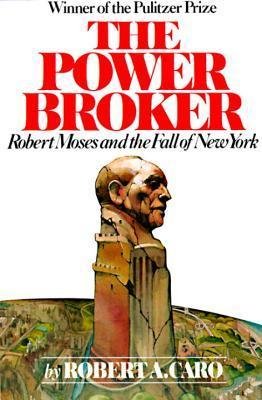
image from Goodreads
“If he was capable any longer of rethinking his policies, he gave no evidence of it. And because of his power, of course, there was nothing that could force him to rethink.”
“Changing realities could have changed his thinking but he was utterly insulated from reality by the sycophancy of his yes men.”
If you are from New York City or have any familiarity with it, this book is for you. If you are interested in public administration or political science, this book is for you. If you are interested in power dynamics and the psychology of power, this book is for you. You should read this book if you are interested in civil engineering or urban planning. If you have an interest in social justice or the 20th Century urban experience, you should read this book. This book is for anyone that has ever been stuck in a traffic jam and thought “who designed this mess?” Robert Caro’s Pulitzer Prize winning biography of Robert Moses is the story of how modern New York came to be. While I rarely recommend 1,000 plus page books, The Power Broker is an exception. Although long, this book is detailed, very readable, and one of the most interesting biographies I have ever read. If you commit the time and energy, you’ll be rewarded with a deep appreciation for public administration, civil engineering, power dynamics, urban politics, and how much one man can accomplish through the sheer power of personality.
At its heart, Robert Caro seeks to answer the question: how does someone, never elected to public office, become the most powerful official in New York? How does one person hold sway over generations of Mayors, Governors, Legislators, and Presidents? Moses worked with and often butted heads with the great historical figures who dominated 20th Century New York politics such as Al Smith, Franklin Roosevelt, Fiorello La Guardia, and Nelson Rockefeller. Moses held multiple positions, often at the same time, as the head of various public authorities with vast power to make public works decisions and seize private property. He used his skills and knowledge of bill writing and legislative process to methodically amass power over decades.
The political dynamics detailed by Caro should be required reading for any student of power. Robert Moses put into practice the theoretical framework Machiavelli laid out five hundred years ago. The result of this power are the bridges, parks, beaches, and highways that make up the New York City landscape today. Modern New York was built, one Robert Moses project at a time. But there was a cost. Caro isn’t an apologist for his subject. Writing in the 1970s, he laments the impact these projects had on the city’s residents, particularly the poor, for whom the public transportation system was neglected. Additionally, the demolition and disappearance of entire neighborhoods to accommodate new highways was, to Caro, egregious – especially since the locations Moses identified for demolition didn’t always make the most sense. Robert Moses insisted all this was done for the public good but as Caro points out, Moses “did not give the slightest indication of understanding that his transportation policies were doomed to failure.” He could not and would not change his mind to the possibility that there was another way. But Moses wasn’t just immune to other ideas, he made sworn enemies of anyone standing in his way. Destroying someone out of spite was not beneath him.
Moses possessed a “romanticism” of the automobile which contributed to the reality that generations of New Yorkers are forever condemned to spend hours each day stuck in traffic – an unfortunate model eagerly adopted by other American cities. Caro suggests that often, public transit could have been developed cheaply and efficiently alongside the new highways. But Moses would have none of it. The automobile and its supporting infrastructure held primacy. It didn’t help that Moses was “utterly insulated from reality by the sycophancy of his yes men.” Any good leader needs to hear dissenting opinions. I believe one of the ultimate signs of insecurity is not welcoming or encouraging a healthy competition of ideas. One can imagine what New York City would look like today if Moses possessed the ability or desire to look past his singular way of doing things. What would the city be like if he encouraged the open expression of alternative viewpoints to his grand plans? Would the urban decay that began in the 1950s slowed? Would the city’s poorest residents have had ready access to public transit, parks, and other urban amenities?
As with others, we find that close-mindedness, the inability to change one’s mind or even entertain alternative viewpoints has consequences. In the case of Robert Moses, the entire landscape and character of a city changed, and to some it was destroyed. Surrounding oneself in an echo chamber doesn’t indicate the rightness of opinion but rather, the unsettling fact that maybe your point of view isn’t strong enough to withstand scrutiny. Leaders with incredible power and influence could do well by remembering not to insulate themselves from reality and to open one’s mind to a different point of view.