The Comfort Crisis: Embrace Discomfort to Reclaim Your Wild, Happy, Healthy Self
by Michael Easter
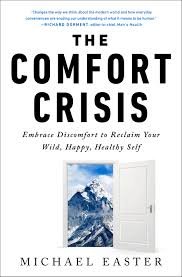
image from Goodreads
“We lack physical struggles, like having to work hard for our livelihoods. We have too many ways to numb out, like comfort food, cigarettes, alcohol, pills, smartphones, and TV. We’re detached from the things that make us feel happy and alive, like connection, being in the natural world, effort, and perseverance.”
“Comforts and conveniences are great but the haven’t always moved the ball downfield in our most important metric, happy, healthy years.”
“Modern humans may have an unmet need to do what’s truly difficult for us.”
The concepts and ideas presented in The Comfort Crisis are ones which every man should embrace. Modern life is one of convenience and comfort. We have found new and novel ways to avoid boredom and uneasiness. Unfortunately, this pursuit of comfort has not made our lives more fulfilling or meaningful. Simply put, we have become weak. Humans were made to do hard things. We were made to face challenges. Easter makes the argument that sometimes, struggle is good. We should not shy away from activities and situations that are outside our comfort zones. He suggests our comforts and modern lifestyles detract from what it means to be human. Does this thesis explain why depression, anxiety, and other conditions are so rampant today? Is pursuing hard physical things the key to decreasing our collective malaise? I don’t have the definitive answer. But I can say that, personally, I never feel more alive and recharged than after completing a truly life-changing physical experience.
Easter uses a month-long hunting trip to Alaska to illustrate his point regarding the power of difficult life-changing experiences. He spent a month outdoors in freezing temperatures, experienced extreme hunger, deafening silence, and utter boredom like never before. Lifting heavy packs (and dead animals) over countless miles and mountains not only punctuates the argument that humans are able to endure infinitely more than modern society allows but that we evolved to do such things. Denying this part of our nature may just be the cause of what ails us. Rather than seeking out and embracing discomfort, we pursue new ways to become more comfortable. The goal post often gets moved to the point where what was once comfortable is no longer. “Today’s comfort is tomorrow’s discomfort,” Easter writes, calling this phenomenon “comfort creep.” Remember the quaint days of the late 20th century before mobile phones, the internet, or streaming services? Imagine the horrors we all experienced going out into the world and interacting with real live people! Now, we can have anything our heart desires delivered directly to our door. Convenient? Yes. But at what cost?
One concept that resonated with me was that of a “misogi.” Misogi isn’t a new idea, it originated as a Shinto ritual meant to “cleanse spiritual, physical, and mental impurities, fostering resilience, self-discovery, and personal growth” by immersing oneself in freezing water. This idea has taken on new meaning in modern times. It is now defined in certain circles as an challenge that is difficult, with a 50/50 chance of failure, designed for personal growth rather than “ego or social media.” This challenge must be well outside one’s comfort zone, resulting in a profound impact on one’s life. Looking back, I have completed multiple endeavors that would be considered a misogi – without even knowing what a misogi was. I recall times I’ve gone on epic camping trips, spent extended time in the wilderness, and endured physical challenges like running long distance races and climbing maintains I had no business climbing. Each has been life changing in its own way. I gained more strength, self-awareness, and yes, happiness. Not every misogi-like experience must result in success. Failure, in some form or fashion, is ever present. For instance, I’ve attempted a rim-to-rim-to-rim of the Grand Canyon a couple times and have failed for assorted reasons (forest fires, knee injuries, unexpected snowstorms). And yet, these attempts all had profound impacts on my life. For years I tried undertaking regular challenges even though I didn’t have a name for it. Now that I have a definition or concept, I can be more intentional with what I’m trying to accomplish.
The other great concept I’d like to unpack from The Comfort Crisis is the slowing down of time through new or novel experiences. The saying “time flies when you’re having fun,” isn’t necessarily true. Easter points out correctly that “people remember duration as being shorter on a routine activity. The slowing down of time happens on a misogi…what was a few hours will seem like days because I remember every detail.” So true. Novel experiences slow down our perception of time. Routine activity, which encompasses so much of modern life, is responsible for making years feel like days. Far too many of us have routines and ruts, with little change from day to day. Yet we wonder where the years have gone. Modern life eschews boredom and we’ve developed more innovative ways to avoid doing nothing. We cure boredom through mindless scrolling on Instagram feeds, TikTok videos or Facebook posts. I marvel at just how many afternoons I’ve wasted by doomscrolling my social media feeds. For what? I will never get that time back. Time flew by and I got nothing out of it besides minor dopamine hits. New and unique experiences that challenge us make life slow down, become worthwhile, and memorable.
Gentlemen, we need to take this book’s lessons to heart. We need to challenge ourselves. We can’t be afraid of hard things. We all need to embrace experiences that will challenge us mentally, physically, emotionally, and spiritually. Years from now what will we look back on with pride and self-accomplishment? Spending two hours in front of tiny screens every night? Or completing a 100-mile ultra marathon in 100-degree heat while rucking seventy pounds up the world’s highest mountain range? Ok, maybe that example was a bit extreme, but my point doesn’t change. Get out there and do hard things. Your life will be better because of it.