Pride and Prejudice
by Jane Austen
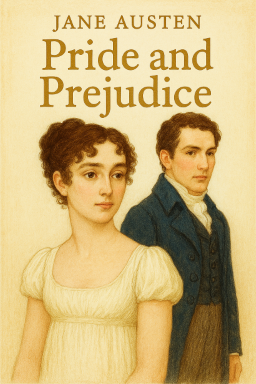
Pride and Prejudice is one of the best known and enduring novels in English literature. Even though there are a myriad of adaptations, knockoffs, and movies, nothing comes close to the witty satirical brilliance of Jane Austen’s most popular work. For the unaware, the story centers around Elizabeth Bennet whose first impressions of the rich, albeit proud Mr. Darcy leave significant room for improvement. It is a fun story and the interactions between the two leads are entertaining, but this book shines in other ways. The satire is infectious, specifically the social commentary on the standing of women in early 19th century England, as is the book’s underlying theme of landing husbands (rich or otherwise). Another area where the book really shines, more than most Austen books, is the secondary characters. They are memorable and encompass one of the best supporting casts in all literature: Mr. Bingley, Mr. Wickham, Mr. Collins, Charlotte Lucas, and of course, Elizabeth’s family – 4 sisters and her parents. Pride and Prejudice is Jane Austen at her finest and, in addition to the social commentary mentioned above, offers an excellent lesson on parenting and fatherhood. It’s a tertiary theme but looking at Pride and Prejudice from that perspective is an interesting and modern take on a two-hundred-year-old classic.
By studying Elizabeth’s parents, Mr. and Mrs. Bennet, and their shortcomings, we glean valuable parenting tips and insights. While Mrs. Bennet is a whole different level of crazy, Mr. Bennet’s failures are more subtle. At first read, he is a sane and respectable father who loves and dotes on Elizabeth. Upon closer examination, however, another figure emerges. Mr. Darcy first points this out to us in his letter to Elizabeth, explaining his disparaging comments regarding her family. Darcy calls out the impropriety of her mother and younger sisters but also the “occasional behavior of her father.” This seemed like an odd comment. But I didn’t know why. Until I re-read it as a new father.
Mr. Bennet’s failures influence his daughters, specifically Elizabeth’s approach to relationships. She knows he is not happy in his marriage. Mr. Bennet and his wife are different people with opposite temperaments. Austen points out that Mr. Bennet was “captivated by youth and beauty and the appearance of good-humor which youth and beauty generally give, had married a woman whose weak understanding and illiberal mind had very early in their marriage put an end to all real affection for her.” Mr. Bennet was stuck in a marriage with a woman he didn’t respect. Rather, he now used his wife’s “ignorance and folly” for his own amusement. Not the best environment for children looking for domestic role models. Elizabeth, though, is clever, smart, and perceptive. She is on the receiving end of his affection, but clearly understands the impact this “unsuitable” marriage has on her sisters. Mr. Bennet also projects his disdain for his wife onto his “silly” youngest daughters, which Elizabeth is astute enough to realize. His talents, she reasons, if “rightly used, might at least have preserved the respectability of his daughters, even if incapable of enlarging the mind of his wife.” Elizabeth’s reluctance and prejudice toward suitors could be partly explained through this lens.
Central to the story is the fact the girls must marry otherwise they will have nothing in the event of Mr. Bennet’s death. Mr. Bennet, however, did nothing to secure his daughter’s future. He realizes his failure by not saving for the “better provisioning of his children and of his wife.” Mr. Bennet assumed he’d eventually have a son, rather than five daughters, who would use his inheritance to look after the welfare of his female family members. Mr. Bennet also played favorites with his children. He even explains his fondness for Elizabeth above his other daughters because “Lizzy has something more of quickness than her sisters.” Between an unhappy marriage, disrespect for his wife, playing favorites with his children, and failing to provide for their future security, Mr. Bennet isn’t exactly the innocent and lovable father we initially encounter.
Pride and Prejudice should be on every Gentleman’s reading list – not just because it is a classic, funny, historically insightful or choked full of great characters. But as a father, it reinforces the fact that my actions matter. What I do impacts the trajectory and attitudes of my children more than I imagine. But it is heartening to know that even two hundred years ago another father was messing up his kids. We can learn from his errors.