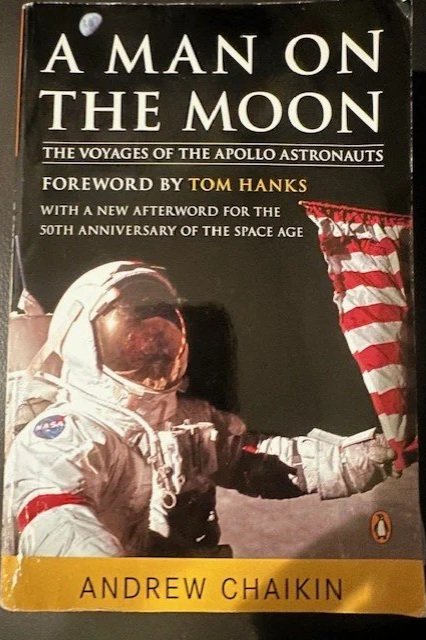
A Man on the Moon: The Voyages of the Apollo Astronauts
by Andrew Chaikin
“…in the compressed moments of a launch or some other critical phase, they became one giant brain, twenty minds wired together in parallel, each focused on some small piece of the whole event. In such situations, they could solve almost any problem that came their way, given twenty seconds to work on it…the amount of information processed by one controller was staggering. And the entire team was trained for that kind of split computer mentality. With that kind of brain power at work, twenty seconds could be a long time.”
“Project Apollo remains the last great act this country has undertaken out of a sense of optimism, of looking forward to the future…It is the sense of purpose we felt then that seems as distant as the moon itself.”
“Instead of letting the moon be the gateway to the future, we have let it become a brief chapter in our history. The irony is that in turning away from space exploration – whose progress is intimately linked to the future of mankind – we were rob ourselves of the long term vision we desperately need. Any society, if it is to flourish instead of merely survive, must transcend its own limits.”
There is something to be said about a 600-page book that I can plow through in less than three days. I could not put A Man on the Moon down. Admittedly, I have a fascination with the early history of NASA and that probably played a part in why this was such an enthralling read. This book is a reminder not only of the other Apollo missions, but all that went into making early spaceflight a success. The Apollo Program encompassed so much more than just Apollo 11 and Neil Armstrong. So much more. I am eternally in awe of the things man can collectively accomplish with a singular purpose and a sense of mission. The Mercury, Gemini, and Apollo programs are perfect examples of this. With the focus of going to the moon a national priority, the collective effort of thousands were put to the test.
A Man on the Moon is a magnificent read which covers each Apollo mission, along with the lives of the NASA astronauts, mission control personnel, engineers, administrators, and their families. Beginning with the horrific Apollo 1 tragedy and ending with the highly successful multi-day lunar mission of Apollo 17, this book goes into great detail about some of the missions beyond Apollo 8, 11, and 13. While those are the most well-known, the equally, if not more fascinating stories are the other missions. And those were no less impactful. I thoroughly enjoyed each lengthy chapter, each devoted to an Apollo mission. Of particular interest were the later missions such as Apollo 15, 16, and 17, where the use of the lunar rover allowed astronauts to travel further on the moon’s surface than ever before. Reading about the last missions, we get a glimpse into what Apollo could accomplish and what it could have been had the program continued. Beyond the lunar landings, we delve into the other intricacies of NASA such as picking crew assignments and rotations, a mystery known only to Deke Slayton (Director of Astronauts), that none of the astronauts ever seemed to figure out. Additionally, we learn about the intense rivalries and competitiveness of the astronauts. The competition between the original Mercury astronauts, the first, second, and third tranches of Gemini astronauts was fierce as they vied for coveted spots on each mission. Also interesting were the astronauts’ training in geology, how they were taught about rocks, and how they decided which samples were most important to bring home. I was engrossed, reading about lunar geology. For the astronauts, it wasn’t merely about picking random rocks, there was a method to the science, and they knew what to look for.
As I read this book, I kept asking myself, “what if?” What if we didn’t stop with Apollo 17? What if we kept moving forward, continuing to send humans to the moon? Where would our species be? Imagine the possibilities. We could be living in a science fiction reality. There is an argument to be made that humanity has regressed since the early 1970s. We were meant to explore, and we had the ability to keep going and keep achieving more, but we stopped. We also stopped dreaming. We stopped accomplishing bold things. NASA had a long-term plan to visit other planets, which seemed so doable in context of where the program was after Apollo 17. But, today, this vision is so far outside our grasp. When Apollo was cancelled, NASA was just hitting its stride. As Chaikin points out, “only three more lunar landings remained… With those remaining missions, Apollo would figuratively and literally reach its greatest heights.” And then suddenly, it was over.
In the end, Apollo wasn’t only about going to the moon. The collective accomplishment and harnessing of brain power for a higher purpose was lost. And it never recovered. Sure, Apollo was expensive, but I think about what might have been. Some achievements can’t be quantified. The sad truth is that Apollo couldn’t exist today. It would require a political and financial commitment that society refuses to pay. Entire generations of mathematicians, scientists, and engineers are required to move humanity forward. That could have been our reality. Want more young people in STEM? Give them a mission and a collective sense of purpose. Give them something greater than themselves to strive toward. Without that, we all stagnate. We no longer think big. Even our political leaders have failed us. Their lack of vision for achieving remarkable things is nonexistent. They do not have a vision of what we can accomplish if we all work together for a common purpose. It doesn’t need to be sending man to space. There are so many things we can do to make earth a better place, but even closer to home we fail. The fact that we cannot replicate Apollo, technically, politically, and societally, is the biggest shame of all.