Les Misérables
by Victor Hugo
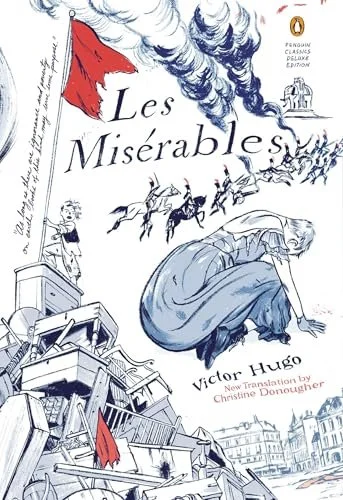
“The bishop went up to him and said quietly, ‘Don’t forget, never forget, you promised to use this money to become an honest man.’ Jean Valjean, who had no recollection of having made any promise, remained dumbfounded. The bishop had dwelled on these words as he said them. He went on with a kind of solemnity, “Jean Valjean, my brother, you’re no longer owned by evil but by good. It’s your soul I’m buying. I’m redeeming it from dark thoughts and the spirit of perdition, and I’m giving it to God.’
“Yet he felt whatever he decided, some part of him was bound to die, and there was no possibility of avoiding this. That either way he was entering a tomb. That he was in the throes of death, the death of his happiness or the death of his virtue.”
“The supreme happiness of life is the conviction that you are loved, loved for yourself, better still, loved despite of yourself.”
Full disclosure, I saw the musical (on stage, not the movie) before I read the book. It’s one of my personal favorite stage productions and I undertook reading this massive book in no small part because of the play. As a result, this review will seem like a compare/contrast between the two versions. The musical follows the gist of the book closely and that made reading it easier. The plot is fairly well known: Jean Valjean is released from prison, breaks his parole, becomes a successful member of society, and spends the rest of his life trying to make amends for his transgressions, all while being pursued by Javier, an uncompromising police official, amidst political uprisings in early 19th Century France. While it is an exciting narrative, potential readers need to be warned. My version clocked in at just over 1,300 pages, so reading Les Misérables is no small undertaking. Hugo even devotes entire chapters to the emotional gymnastics of the characters. While Les Misérables is a commitment, that commitment is rewarded with a book rich in historical drama, as well as complex characters struggling with their own circumstances and contradictions. Overall, this is a fantastic read. That said, the size, complexity, and small print is enough to turn off most readers. My opinion? It is still worth the time and effort.
As mentioned, the plot, the characters and their motivations are similar between the book and the stage production. Missing from the musical are their nuanced and detailed backstories. I now have a much richer appreciation of the characters the stage version shortchanged, especially Marius and Fantine. A thousand-page book simply provides more depth for these tortured souls to inhabit. What makes these two particularly compelling just doesn’t come across in a three-hour production and, to me, the most fascinating parts of the book were absent on the stage. Fantine’s backstory, for instance, is tragic and is only partially encapsulated in the powerful song, ‘I Dreamed a Dream.’ Marius is a much deeper character and has more complex relationships with Jean Valjean and Thenardier than the play lets on. He is always searching, thinking, and reconsidering what he knows or previously assumed. The book also provides further insight into others like Gavroche, and the reason Javier is so fixated on bringing Jean Valjean to justice. Unfortunately, besides a very compelling Fantine, the rest of the female characters are short changed. Eponine is one of the most interesting females in the stage version, with emotionally charged songs. But I was never really moved by her story in the book. Cosette seemed particularly wooden and little more than a prop to move the narrative forward. This was my impression of her in both versions.
What the book also provides, as much as character development, are tangents. This is one of the biggest criticisms I’ve heard regarding Hugo. Les Misérables is infamous for going off in directions unrelated to its primary narrative. Pages upon pages are devoted to the Battle of Waterloo, Paris street urchins, slang, convents, and even the city’s sewer system. In fact, the first sixty pages or so are only tangentially related to the rest of the book. This is not a complaint as much as an observation. Admittedly, since I knew the story in advance, I did not devote as much mental energy to these chapters and digressions. Which brings me to a controversial opinion: sometimes reading an abridged version isn’t such a heretical concept. In this case of Les Misérables, reading an abridged version doesn’t take away from the story at all. Had I not been familiar with the story, these long tangents may have seriously distracted me from the overall enjoyment of the book. But, even with these unrelated meanderings, this is still a must-read book that should be on every gentleman’s reading list.
Two lessons became apparent while reading Les Misérables. First, people can change. Second, while we may not realize it, one good deed can not only alter someone else’s life but can positively impact multiple lives and generations. Jean Valjean, filled with anger and hate at everyone, is pitied and forgiven by a priest for a crime. After that moment Jean Valjean begins to set himself straight. When he discovers that he may have done Fantine wrong, he dedicates his life to her final wish – ensuring that her daughter Cosette is cared for, which impacts the trajectory of her life. Jean Valjean discovers that love can give one’s life meaning. Javier, on the other hand, devotes his life to pursuing and punishing Jean Valjean. He rejects the notion that people are malleable. Everything is black and white, and it’s inconceivable that someone that once was bad can change or ever become good. In contrast to Javier, Marius continually reconsiders what he knows and updates his thinking as new truths emerge. Once he finds out Jean Valjean’s past, Marius’ reaction is to cut him off from Cosette. He finds ways to keep her from seeing her “papa.” His suspicion of Jean Valjean grows as he thinks he knows the full story. But to Marius’ credit, he welcomes the truth when it's presented, rather than ignoring the facts in front of him. This was something Javier was incapable of doing. So often we are more like Javier than Marius. We think we know the full story. Rather than accept new realities we remain stuck in our old way of thinking. Les Misérables is a good reminder that change is not only possible but required for a good and fulfilling life. We shortchange ourselves and others when we are unable to see the truth right in front of us.