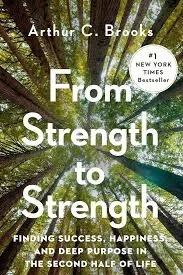
From Strength to Strength: Finding Success, Happiness, and Deep Purpose in the Second Half of Life
by Arthur C. Brooks
“Here is the reality: in practically every high skill profession, decline sets in somewhere between one’s late thirties and early fifties.”
“Devote the back half of your life serving others with your wisdom. Get old sharing the things you believe are most important.”
Few things pack a punch to the gut quite like someone telling you that you’ve hit the wall. It hurts when we are told our strength, stamina, energy, and even great ideas are in the past. This realization is painful. It’s a tough pill to swallow. Fortunately, no one has said this to my face. Then again, I’ve never been a world class athlete or a renowned academic developing the newest theoretical breakthrough. That said, if I’m honest, I know I’m slowing down. I am not as quick as I once was – physically and mentally. When I would debate someone on a hot political issue, I was always ready with a response or quip. I was quick. However, looking back, most of my responses were actually ill-informed and shallow. These days, although I’m not as fast as I once was, I’m more nuanced, able to synthesize concepts in multiple angles. This is what age provides, we replace quickness with thoughtfulness, novelty with wisdom.
From Strength to Strength forces us to confront the reality of getting older. But aging does not have to mean we accept slowing down. While we may not be as agile or productive as we once were, we possess other strengths we can utilize in the back half of life. It’s about looking for strength in other ways. We need to find new strengths and move toward those. Many of us hold onto our past glories longer than necessary. Don’t try to compete with your 25-year-old self at the same game. Find a new game. For the work addicted, this doesn’t mean things are over. It just means that there may be a better use of your new strengths that you’ll need to harness.
Brooks explain how our fluid intelligence peaks in the early part of life but once that declines, we can lean on our crystallized intelligence – making intellectual connections, synthesizing complex ideas, and imparting wisdom to subsequent generations. Roughly speaking, fluid intelligence relates to reason, flexible thinking, and problem solving. Crystalized intelligence on the other hand is the ability to use one’s stock of knowledge and know how to apply it. As he points out, “when you are young you have smarts, when you are old you have wisdom. As the saying goes, ‘knowledge is knowing that a tomato is a fruit. Wisdom is knowing not to put it in a fruit salad.’”
Initially, this entire premise stung me a bit. Then, I started reflecting. I realized this book found me at just the right time. My priorities have changed – without my realizing it. I’m ambitious, although not as ambitious as I once was. I am still driven, but it’s now different. Have I slowed down a bit, mentally? Maybe. If so, I haven’t noticed. What I have noticed is that I have a greater ability to make connections as well as an increased enjoyment mentoring others to do what I used to do. Developing creative solutions to complex problems is no longer my job. I now have people to do that for me. What I now possess is the institutional knowledge I’ve built up and the ability to apply it to new scenarios. I have people that can work through problems and create novel ideas. I can provide direction, dictate a project’s parameters, and offer synthesized guidance based on past experiences.
Even if I don’t think I’ve lost something mentally, I find myself gravitating toward tasks that allow me to teach, mentor, and guide the next generation. In my mind, I’m still not that old, but I like being the one people go to and bounce around interesting and new ideas. It provides me immense satisfaction to be a sounding board when others want to know about potential pitfalls and hidden obstacles. I have reached a point of contentment and no longer have the burning desire to move up the metaphorical ladder to accomplish even more. It’s a good spot to be in. And if I can offer my experiences to others so that they can think of new and better ways of doing something, then great! And that is the point Brooks is making. Focus on developing new strengths instead of continuously comparing yourself to your previous accomplishments and striving to surpass them. Remember, “great gifts and achievements early in life are not simply an insurance policy against suffering later on.” What a great reminder not to rest on past laurels. Instead, find new ways to seek fulfillment and accomplishment later in life. Your happiness depends on it.