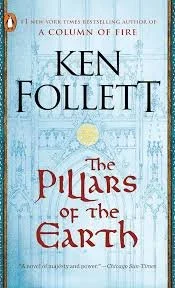
The Pillars of the Earth
by Ken Follett
“It did not occur to them that a woman could be dangerous. How foolish they were.”
“Human beings have the capacity to rise above the mundane circumstances and touch the eternal.”
“Excessive pride is a familiar sin, but a man may just as easily frustrate the will of God through excessive humility.”
“When things are simple, fewer mistakes are made. The most expensive part of a building is the mistakes.”
The Pillars of the Earth is ambitious. It’s an epic book spanning fifty years of eventful Medieval history. It is also one of my favorite novels. And that is saying something, considering it’s a nearly one-thousand page beast centered around cathedral building in the 12th Century. The backdrop is the English “Anarchy,” a period where rival factions of nobility and clergy navigate the perilous game of power politics, where upon the momentary whims of the monarch, people’s fortune and fate spin. Through this tumultuous time, when England is at war with itself, the building of the cathedral continues. Through sheer willpower, perseverance, and a unity of vision led by a godly monk, the Master Builders deal with the on-going power struggles between King Stephen and Empress Maud (Matilda), along with corrupt bishops, bloodthirsty earls, scheming merchants, as well as their own ambitions and desires. The book touches on gender roles and women’s place in society, the interplay between monarch and the church, the legacy of art, and creating something that will last for centuries. It asks whether building something grand and beautiful such as a gothic cathedral is done for the glory of God or for one’s own vanity. It examines power and politics. It is about redemption and the forgiveness of sins. Specifically, does someone with a lifetime of sin against their fellow man deserve forgiveness and salvation in their final moments? Or are they forever damned for a life of murder and rape?
Pillars of the Earth takes conflict – political, interpersonal, natural, religious, and familial – to a whole new level. Obstacles continually arise and much of the book’s fun is trying to determine how everyone will deal with whatever crisis arises. The characters’ ability to persevere is remarkable. Prior Phillip, for instance, is stymied time and again in his singular quest to build the cathedral, continually questioning his motives and asking himself if he is building it for God’s glory or for his own. As he experiences each problem, he begins doubting whether the cathedral is really God’s plan and if the setbacks are punishment for his own hubris. Along with Phillip, the large cast of characters each have their own motivations, and it is interesting to see how their individual goals somehow dovetail with the Cathedral. I enjoyed how wits were matched between the earls, bishops, knights, monks, masons, merchants, serfs, and monarchs with unexpected results. Alliances shifted depending on the circumstances, yet their actions were consistent with their underlying purpose. These characters were shaped by events, yet they did not always accept their lots in life. They sought ways to further their advantage, even when they were down. Pillars of the Earth is a master class in recognizing and seizing opportunities when they arise and making the most of each situation, even when things don’t go your way. No one character remained on top for long and each chapter brought new challenges and roadblocks. Yet, if there is something this book can teach us, it’s perseverance. We all get knocked down. But we must notice opportunities and keep marching toward the finish line.
There is much to say about this novel. If one can make it past the first fifty or so pages, they will be rewarded with one of the most unexpected works in modern historical fiction. The book’s character development kept me engrossed in the story and anxiously waiting to see what happens next. I was invested in these characters – both the protagonists and the antagonists. The world building is first rate and rivals any fantasy or science fiction book I’ve ever read. I could see and feel the characters as they might have lived nine hundred years ago. Over the decades in which the book takes place, characters come and go, yet the Cathedral continues. And while Pillars of the Earth doesn’t have a large and epic climax, Follett ties up the loose ends in a mi d satisfying conclusion. In sum, this is one of the best historical fiction books I have read. It has something everyone – history, romance, violence, murder, mystery, religion, politics, philosophy, and yes, even medieval architecture.