Benjamin Franklin
by Walter Isaacson
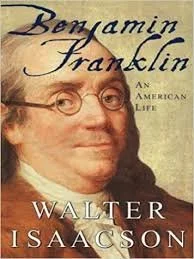
“But the most interesting thing that Franklin invented, and continually reinvented was himself. America’s first great publicist, he was, in his life and in his writings, consciously trying to create a new American architype. In the process he carefully crafted his own persona, portrayed it in public, and polished it for posterity.”
“I would rather have it said, ‘He lived usefully’ than ‘he died rich.’” – Benjamin Franklin
“Declaration of fixed opinion, and of determined resolution never to change it, neither enlighten nor convince us.” – Benjamin Franklin
America’s founding fathers are a fascinating bunch. Their backgrounds were varied, their collective intelligence was astounding, and their philosophical disagreements were legendary. They were by no means a monolith of singular purpose. They each wanted America to succeed but each had profoundly different viewpoints on what that looked like and how to make it happen. Benjamin Franklin, by far the oldest and up to that point, the most accomplished, had already lived a lifetime when the American Revolution broke out. But his life to that point was just the beginning. In his remaining years, Franklin didn’t slow down, rather. Rather, he had his hands inbusy developing each of the pivotal documents of America’s founding – The Declaration of Independence, the Alliance with France, the 1783 Treaty of Paris, and the U.S. Constitution. His story is something that requires study by all gentlemen. Franklin’s life is worth examining because he didn’t go quietly into the night and found new ways to use his talents and intellect. He reinvented himself constantly and in each of life’s chapters, found purpose. And that is undoubtedly one of the things Franklin would be most proud of, that he stayed useful and was effective until the end.
Isaacson’s masterful biography is comprehensive, balanced, and portrays a man who just wants to be useful. Isaacson details how Franklin cultivated his image and the various characters he created. From Silence Dogood and Poor Richard to the image of himself he carefully crafted in his autobiography, Isaacson illustrates the motivations, contradictions, and events that shaped how Franklin viewed himself and how he wanted others to see him.
He was America’s first polymath. He was an entrepreneur, a printer, writer, postmaster, diplomat, scientist, inventor, public servant, community activist, the founder of libraries, hospitals, colleges, a militia colonel, editorialist, and politician. And this was all before the pivotal events of 1776. Even without his contributions to the young nation, Franklin still may have been a household name today. But at a time when most people died well before their seventies, Franklin was just getting started. As the quote above suggests, over the years he found ways to invent and reinvent himself. And that is instructional for all gentlemen. We can have a second and third act. We can follow our passions. And most importantly, we can be useful and contribute to society. After turning seventy, Franklin played a pivotal role in the 2nd Continental Congress, he traveled to France as a diplomat trying to secure French support for the American cause. The war’s conclusion was far from certain, and Franklin deftly navigated French politics during a critical and perilous time. As the war concluded, his efforts centered around the peace treaty with Great Britian and securing the best possible terms for the new United States. Not to be outdone by himself, Franklin, at 81 years old, went on to become a delegate at the Constitutional Convention. These endeavors came at a price and his strained relationships with family members, particularly his son, serves as a cautionary tale of placing political differences above familial bonds.
When examining Franklin’s life for lessons, I could have taken any of a variety of angles. There are many different ways one could learn from Franklin. I thought about using Franklin’s life as an example of self-help and continual self-improvement. He developed methods to perfect himself and craft himself into the ideal person. I could have written about the importance of following one’s interests. Another angle I wanted to explore was his open-mindedness which allowed him to amend his opinions when the situation changed and accept new facts as they arose. He always examined and reevaluated his viewpoints. Franklin wasn’t overly dogmatic even though he had guiding principles. But I kept coming back to his work, contributions, and the influence he had in his later years. He retired from his printing business in his forties. He used his free time to further engage in civic improvement endeavors as well as scientific inquiry and inventions that he hoped would be useful. When politics called, he answered. Rather than settling down into a life of leisure, he dedicated the next forty years to public service.
One of the sections I really enjoyed reading about was Franklin’s role in negotiating the Treaty of Paris, which ended the Revolutionary War. Most importantly, this was the document that recognized the United States as a sovereign nation. He dealt not only with multiple English representatives but also contended with the French, who felt they were owed something for helping the new United States. He balanced the interests of everyone while still getting exactly what he wanted from the treaty. Franklin even maneuvered around the backstabbing from others within the American delegation. As Isaacson points out, “from his opening gambit that led to America’s treaty alliance with Frace to the endgame that produced a peace with England wile preserving French friendship, Franklin, mastered a three dimensional chess game against two aggressive players by exhibiting great patience when the pieces were not aligned and carefully exploiting strategic advantages when they were.”
Facing my middle-aged life, I particularly enjoyed knowing that one’s usefulness and purpose can continue until the very end. And that may explain Franklin’s longevity: he had a purpose, a reason for living. This begs the question, what interests and passions do I have that I can follow? What gives me purpose as I approach the next chapter of my story? For me? Educating and teaching others. Finding books and making recommendations on how we can live better lives. Franklin is one of those figures from which we can always learn something new. Fortunately, the library of books on Franklin is vast. And I am always on the lookout for more as he is such an interesting character. If anyone is interested in reading more on Franklin, I highly recommend The Autobiography of Benjamin Frankin, which covers his early life until he left for England as a diplomat in the 1750s. He worked on it for years but never completed it. Another is Ben and Me by Eric Wiener. This book is a compellation of life lessons we can glean based on Franklin’s life, some of which I listed here. But if you want an excellent one volume biography that is entertaining, balanced, and comprehensive, I cannot recommend Walter Isaacson’s Benjamin Franklin enough.