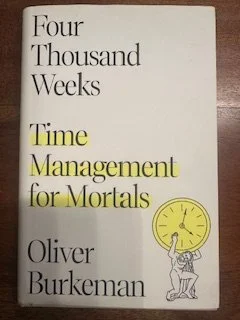
Four Thousand Weeks: Time Management for Mortals
by Oliver Burkeman
“Productivity is a trap.”
“In practical terms, a limit embracing attitude toward time means organizing your days with the understanding that you definitely won’t have time for everything you want to do – and so, at the very least, you can stop bearing yourself up for failing.”
I like lists. I like compiling to-do items, daily and long term, into lists. I like the feeling of crossing off completed tasks. I obtain immense satisfaction looking at a page of crossed off items. There is a sense of accomplishment. My desk drawer is full of journals containing spreadsheet-like grid patterns, tracking my goals, daily progressions, bucket list items, as well as deep reflections regarding how well I’m doing toward completing my aspirations. I’ve even been known to add an already completed item to my list, just so I can cross it off. My default setting when looking at a page full of to-do items that never seem to get done is mental dissonance. I feel unproductive and useless, a failure. Therefore, I’ve attempted a variety of strategies and productivity hacks to keep undone tasks to a minimum. The results are mixed at best. This is a book for anyone that can relate to my struggles.
Burkeman’s premise is a hard but necessary truth that productivity nerds like me need to hear: there isn’t and never will be enough time to accomplish everything. Instead, focus on the few things that matter and don’t stress the rest. This concept can be uncomfortable. Our time is finite – we may have, on average, 4,000 weeks. Why spend precious time trying to accomplish everything, failing miserably, and stressing about what is unfinished? This is an impossible endeavor. Embrace the finite. It’s freeing.
Let’s talk about bucket lists. Many people have one. In addition to my dopamine inducing to-do lists, my bucket list continues to grow, with only a couple check marks to indicate my accomplishments. Travel was always my passion and, as a younger man, I even had some notable adventures in exotic locales. Now, because of my job, kids, and other mid-life responsibilities, I can no longer leave on a moment’s notice to hike the Andes or dive the Great Barrier Reef. Will I eventually make these trips? I don’t know. Maybe or maybe not. The key is not stressing about it. A big step for me was accepting that my life isn’t a failure if every item on every list isn’t crossed off. That realization was a moment of profound personal growth. My mental clarity improved. Instead of focusing on what I am not doing, I just need to be present in the moment. Right here. Right now. This exact moment won’t last forever, and my precious time shouldn’t be spent ruminating about the snail’s pace of completing my bucket list.
What are my present priorities? Rather than trapsing across each continent while my milage account grows to epic levels, I’m watching my daughter star in her school play. I’m taking my kids on bike rides. We watch baseball games together. It may be boring, but these experiences bring me so much joy that I am OK with the tradeoff. Not to say I am not interested in unique travel experiences, but right now, at this moment, I’m content. These experiences are exactly how I want to spend this small portion of my allotted 4,000 weeks. My kids will only be this age for a couple of years, and I don’t want to miss it. It feels good not sitting around stewing about all the things I could be doing but am not. That said, I’m still able to prioritize the occasional backpacking trip. While these adventures are not as epic as they could be, they are, at this point, enough. Sure, I keep my eyes open for exciting opportunities should they arise, but I’m no longer measuring my life’s worth on whether I finish my Appalachian Trail thru hike or summit the highest peaks in each state.
I was following a friend’s Facebook page recently. She’s my age, single, has disposable income, and she travels. A lot. She is always posting pictures from spectacular places. I am genuinely happy for her and that she is doing what she loves. But more importantly, I was happy at myself being happy for her. Not that long ago, I would have made myself miserable wishing I too traveled to all these places. I would have agonized that I wasn’t doing all these great and interesting things in cool locations. Would I still like to visit these places? Of course. But I know that to get the most out of my 4,000 weeks, I must focus on the present and not fuss over all the things I am not doing. And that, I think, is the point.
Burkeman suggests, and I agree, that we must “pay attention to every moment, however mundane, to find novelty not by doing radically different things but by plunging more deeply into the life you already have.” A short life becomes about choices and recognizing that “the undoable reality of a finite human life is that you’re going to have to choose.” Choosing doesn’t mean settling. But you will have to be intentional, narrow the list, make a plan, and then set out to do what you’ve chosen. Remember, however, that plans are not written in stone. They should be ever-changing. If circumstances change, adapt. But most importantly, don’t beat yourself up for failure to accomplish everything on your list. There isn’t enough time for it anyway.