by Yuval Noah Harari
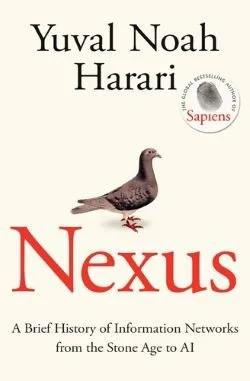
Image From Goodreads
“The main argument of this book is that human kind gains enormous power by building large networks of cooperation, but the way these networks are built predisposes us to use that power unwisely.”
“Contrary to what the naïve view of information says, information has no essential link to truth…Rather, what information does is create new realities.”
“Homo Sapiens didn’t conquer the world because we are talented at turning information into an accurate map of reality. Rather, the secret of our success is that we are talented at using information to connect a lot of individuals. Unfortunately, this ability often goes hand in hand with believing in lies, errors, and fanaticism.”
If there is one truth we’ve uncovered in the digital age it’s that even though more information is available to us than ever before, we are more, not less, susceptible to misinformation. Information networks, which may seem like a boring topic, is at the center of Nexus, the latest book by Yuval Noah Harari. This book is both a history of information dissemination but also a warning about how the stories we tell create our reality and our truth. It’s these stories, and not necessarily facts, which are responsible for human progress, wars, nationalism, and power. From stone age tablets to carefully curated holy books, to radio, the internet, and now artificial intelligence (AI), the story of human history is one of the stories and narratives we create.
Throughout history, humans have had an uncanny ability to connect to each other like no other species. We do this through stories. Everyone uses stories to curate their world view. And stories create our reality, our views, our connections, and our belief systems. Much like 1984’s Big Brother, the one controlling these information networks, controls the story. And whoever controls the story, controls a society’s shared reality. This is why freedom of the press and freedom of speech are so important in a democratic system. This is why self-correcting mechanisms in a democracy along with robust checks and balances are so crucial. We need competing stories which help us find the truth rather than the narratives that are fed to us. Why are politics so divided right now? I’ve often questioned how there can be two (or more) starkly different world views, each with their own reality. How is it that my reality is so different than someone sitting right next to me? How can they not see what I see? What do they see that I don’t? It isn’t just the news that is consumed or the social media outlets one frequents. It is simpler than that. At the most basic level, the stories, and the narratives we believe make up our world view.
Harari paints a dire picture of what this means for mankind moving forward. Though the book’s premise is not necessarily original – particularly on the dangers of AI – he frames the problem not as technological but rather something more elementary: information networks. Nexus lays out a convincing argument about the history of how these stories feed a common narrative people could rally around. From religious texts to books and national origin myths, people have always used information networks to keep people servient. In a world with AI, these narratives become exacerbated. Misinformation, always a problem, looms large. False narratives in the hands of authoritarian regimes can be used to control a population. Whether this book’s warning is prophetic or simply a cautionary warning remains to be seen. Either way, it doesn’t take an astute observer to see that this could turn out very poorly if we are not vigilant.
It strikes me that one of the most important things gentlemen must do to keep from being manipulated by misinformation is to constantly question the stories and assumptions we hold dear. We must be skeptical. Take an audit of your deepest opinions and beliefs and challenge them. The point of The Gentlemen’s Reading List is to question what we know and to continually seek truth through reading. To challenge our beliefs and what we know. If we don’t question the stories we tell ourselves and the constructs that make up our reality, we may easily fall into a false narrative which gives us an illogical world view. Opinions are good. They are necessary. But opinions should not be so fixed as to limit our ability to see the facts. Unfortunately, most will never alter their opinions and beliefs because it is so wrapped up in one’s identity. Read this book, however, and you will see how populism and authoritarianism gain traction, why checks and balances are crucial, and how self-correcting mechanisms are a nonnegotiable feature of a free society. It will also come as no surprise that tech companies and social media have failed us when it comes to the spread of misinformation. It is an interesting paradox of the information age that more access to information does not lead one to truth. People are still simple creatures that will grab onto the easiest narrative that fits their world view – whether true or not. Hence, it is incumbent on us to actively question the stories we tell ourselves, why we believe what we believe, and challenge that narrative.