The Wide Wide Sea: Imperial Ambition, First Contact, and the Fateful Final Voyage of Captain James Cook
by Hampton Sides
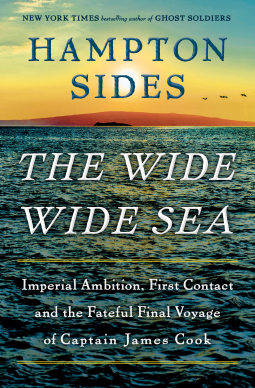
Image From Goodreads
“When one thought about it, what was perhaps more surprising than Cook’s violent death was that is hadn’t happened earlier at some other island.”
I am a sucker for books about the Age of Exploration. I am fascinated by stories of the sea, naval history, and disastrous sea voyages. Therefore, it was little wonder that I was drawn to Hampton Sides’ The Wide Wide Sea. Captain James Cook was one of the greatest British explorers of the 18th Century. His voyages and discoveries across the vast Pacific Ocean as well as the Arctic and Antarctic are legendary. With two successful voyages under his belt, Cook was asked to lead a third, this time to find the elusive northwest passage – from the Pacific. And it is Cook’s fateful third voyage that is the focus of this phenomenal book. Sides gives only scant attention to his two previous voyages but that doesn’t seem to take away from the book’s overall narrative, even for one that may not know much of Cook’s history. On this voyage, he visits modern day Tasmania, New Zealand, Tonga, Tahiti, and he “discovers” the Hawaiian Islands. He explores the coast of what is now Oregon, Vancouver Island, and he follows the incredible coastline of Alaska up into the Arctic Ocean, making a hasty retreat just before the sea ice begins closing in.
Besides Cook, Sides profiles several supporting characters that accompanied Cook on this voyage. There was Mai, a Polynesian who spent several years in England and was getting a ride back to his native island near Tahiti. There was Vancouver, whose subsequent trips to the Pacific Northwest provided his namesake to certain parts of modern British Columbia. There was the voyage’s second command, Clerke, who left a debtor’s prison with tuberculosis and survived conditions from the tropics to the Arctic while inflicted with the disease. And there was a dour but capable young officer named William Bligh. Yes, that Bligh.
I’ve always enjoyed Hampton Sides’ books – two of my personal favorites are Blood and Thunder and In the Kingdom of Ice – so I braced myself for a fast paced read on a subject in which I was eager to learn more. I was not disappointed. What I did not expect are the leadership lessons, good and bad, one can learn from Cook. The Wide Wide Sea paints a mixed picture of Cook, neither lionizing nor demonizing him. On this third voyage, he wasn’t the same man he used to be. He was still the expert navigator and mapmaker and at times showed fairness and leniency to his crew - but he was also increasingly cruel and erratic, traits he wasn’t known for previously. As Sides points out, “veterans of his previous expeditions had noticed the change and were troubled by it.” On the other hand, he still maintained many positive qualities, especially in dangerous situations because of his “calmness in a crisis. Perhaps this was the most impressive quality Cook possessed: in clutch situations he always seemed to know what to do.” In addition, he believed in minimal exertion of energy or explanation: “make the tiny correction and leave it alone.”
One of the skills a leader needs to possess is the ability to question and re-question what they know. Too few exhibit this skill, and I would suggest the mark of a weak-minded leader is one that fails to examine his or her beliefs, especially when the lives of others are at risk. In one short but telling scene, Cook is challenging what he knows and thought he knew about ice formation – specifically that sea water does not ice over. It was thought that in the summer a northwest passage could be found at northern latitudes because the sea water doesn’t become ice. The crew “was fascinated to watch Cook grappling with the ice and constantly refining his ideas.” Leaders cannot be wedded to ideas and opinions, especially those that fly in the face of evidence. When everyone else, including one’s subordinates, can sense reality, it does a leader no good to cling onto something everyone else knows is false. But one doesn’t always need to make wholesale changes. Make small incremental adjustments when correcting course. Before you know it, you’ll be on a whole new trajectory. Make a small adjustment, rethink, make another small adjustment. It is also easier to get buy-in from those that see you are not just making changes for the sake of change.
Whether we are corporate leaders, political leaders, leading small teams, or one’s family, this is solid advice and an example to follow. I lead teams and I believe firmly in the power of small adjustments. I consistently look at how I’ve assigned personnel. I question whether the right skill set and personality are working on various projects. If I sense something isn’t working, I make a minor change, if that works, I leave it alone. If it doesn’t, then I will make another adjustment. Wholesale change, without knowing the 2nd, 3rd, or 4th order effects do no one any good, although it may make the leader seem like they are doing something important. Slight adjustments also keep a leader from becoming too wedded to a particular course of action. In short, don’t assume you know best, lean on reliable subordinates, challenge your existing knowledge, and make small course corrections until the situation resolves itself. Ironically, Cook died in a fatal skirmish with native Hawaiians after failing to adhere to his own leadership style. In other words, poor leadership has consequences.