The Psychology of Money: Timeless Lessons on Wealth, Greed, and Happiness
by Morgan Housel
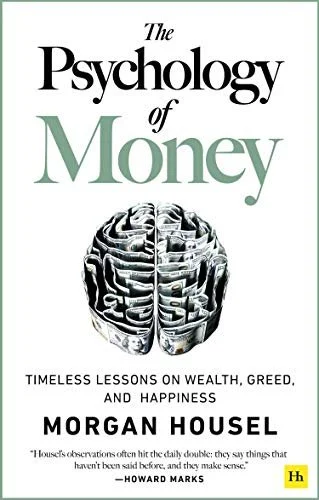
Image From Goodreads
“…financial success is not a hard science. It’s a soft skill, where how you behave is more important than what you know.”
“We all think we know how the world works but we’ve all only experienced a tiny sliver of it.”
“Everyone has an incomplete view of the world. But we form a complete narrative to fill in the gaps.”
With so many personal finance books occupying bookstore shelves, it can be intimidating to figure out which ones are good, bad, or a complete waste of time. I’ve read my fair share, hoping to glean a bit of extra knowledge I can use in my personal finance journey. I’m usually disappointed. Some are repetitive, offering little added information. Other books promise schemes to get rich quickly, which I try to avoid like the plague. Morgan Housel’s The Psychology of Money is different because it approaches personal finance from an alternative perspective. Rather than focusing on one-size-fits-all formulas and preaching non-emotional rationality, we read that personal finance is about how we behave. Outcomes are determined more by our mental models and how we view the world. It comes down to how we make sense of everything around us, often using incomplete information to make decisions. Looking at money through the realm of psychology and personal behaviors begins to make a lot more sense because as humans, none of us are always 100% rational. Emotions matter. Individual experiences matter. And each person’s unique situation matters.
It all boils down to one key idea: personal finance isn’t about math; it’s about behavior. If it were all math, the answers would be much easier to determine. Rather, we must consider so many other variables. For instance, an individual’s risk tolerance, their time horizon, mental models, firsthand experiences, aversion to change, individual world view and even their political persuasion matter. These are distinctly human factors that mathematical models cannot neatly account for. And yet, they determine how we interact with money and financial decisions. Housel sums up this idea when he mentions, “spreadsheets are good at telling you when the numbers do or don’t add up. They’re not good at modeling how you’ll feel when you tuck your kids in at night wondering if the investment decisions you’ve make were a mistake that will hurt their futures.”
We all think we know how the world works. But the world is so much more than our own personal bubble. That said, our experiences and feelings matter so much more than we realize when it comes to money decisions. Housel points out that, “personal experiences with money make up maybe 0.00000001% of what’s happened in the world but maybe 80% of how you think the world works.” Once we realize how little we know, our decision-making process changes. We will be able to recognize our gaps and avoid short-sighted choices based not on having all the facts. I was having a conversation with a financial advisor I know. He was telling me how often his clients try to make short-term money decisions based on political affiliation. Some clients will want to invest more than they planned, take larger risks, or even divest their life savings solely based on which party is in control of Congress or the White House. Just looking at S&P 500 growth from 2021, if someone with an index fund had sold their shares based only on whether Biden or Trump was President, they would have missed significant growth to their portfolio. But politics is emotional and as humans we cannot always get our feelings out of the way.
Another aspect of personal finance behavior that warrants discussion pertains to “playing your own game” and not being influenced by others playing a different game. Knowing your time horizon, risk tolerance, and comfort level of each investment are all parts of your own personal finance game. Additionally, you should identify the goalposts you’re aiming for and not move them. I have a friend who is a big supporter of crypto currencies. He has invested in several and he keeps trying to get me to invest as well. So far, I haven’t. Not to say I never will, but crypto currencies is the game he’s playing. It isn’t my game. I have another friend that pitches me new stock ideas each time we talk. Again, not my game. A long time ago I made the decision to invest a fixed percentage into diversified index funds. I have a specific time horizon I’m working toward, and I’ll adjust my specific allocation as I inch closer to my target date. Every few years, I’ll re-evaluate where I am at and what is working or not. It is boring but it works for me. Am I missing out of something big with my strategy? Maybe. Could I be making more? No doubt about it. But I am playing my game. The most important aspect of my game is that I will not touch the money by taking it out of my investments before its time. Backing up my particular strategy is a quote by Charlie Munger that Housel uses several times throughout the book. “The first rule of compounding is never to interrupt it unnecessarily.” This is the classic example of how one’s behavior matters more than intelligence when it comes to money.
It should be noted that this isn’t a book about playing it safe. It is a book about recognizing your knowledge is limited, realizing blind spots, and understanding that your individual behaviors matter more than calculators and spreadsheets. Most of all, being reasonable is better than being coldly rational because “reasonable is more realistic and you have a better chance of sticking with it for the long run, which matters most when managing money.”