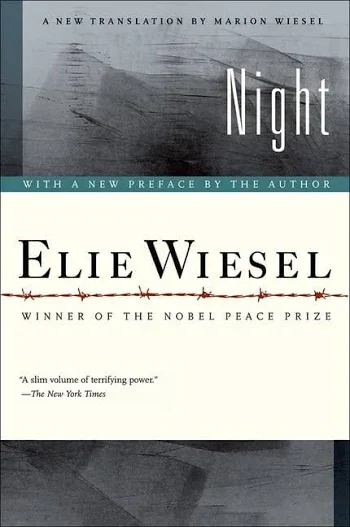
Night
By Elie Wiesel
Those who kept silent yesterday will remain silent tomorrow.
Still, I told him that I could not believe that human beings were being burned in our times; the world would never tolerate such crimes… “The world? The world is not interested in us.”
At last, he said wearily: “I have more faith in Hitler than in anyone else. He alone has kept his promises, all his promises to the Jewish people.”
There are so many books I’ve read that I completely forget about once I finish. Within weeks I fail to recall anything memorable, lest I go back and review my notes and highlights. Night by Elie Wiesel is not one of those books. I read it years ago and recently picked it up again. The horror, the pain, the suffering, the cruelty, it stays with you. And while I had different takeaways after each read, my primary reaction is unchanged: I was and still am angered and heartbroken over what humans can perpetrate upon other humans. The difference this time? Disgust toward those who never spoke up against the injustice around them.
Elie Wiesel was a teenager in 1944 when his family was shipped off to Nazi concentration camps. Initially they were transported to Auschwitz, where he was separated from his mom and sisters. Recalling those first moments in Auschwitz, with a language both haunting and eerie he says, “I didn’t know this was the moment in time and place where I was leaving my mother and [sister] Tzipora forever.” He moved to various camps with his father, finally ending up at Buchenwald. The narrative follows his labor camp experiences, the forced marches, executions, hospital visits, starvation, and the deaths of so many around him.
Night packs a punch. This book is horrific and poignant. I was emotionally wrecked after the first reading and was equally wrecked reading it again. Of course, the atrocities committed by the Nazis make for gut wrenching reading, but what moved and angered me this time was Wiesel’s description of the world’s indifference. These were crimes against humanity, and people didn’t speak up. As the quote above indicates, the world was not interested. Just like today, if one is not affected personally, they tend to remain silent. Even within Elie’s close-knit Jewish community, there was widespread disbelief, even denial and ambivalence. When learning about a fellow Jewish man’s personal experience with the Nazis, Wiesel writes that there were widespread accusations about his exaggerations and “people not only refused to believe his tales, they refused to listen. Some even insinuated that he only wanted their pity, that he was imagining things. Others flatly said he had gone mad.”
This book is not just a memoir of the holocaust but a rebuke. It is a rebuke of mankind’s indifference. It is an admonishment of our collective silence regarding injustice and the suffering of others. The fact that the world was either not paying attention or did not collectively speak up against these horrors is an indictment on us all. Unfortunately, persecution didn’t end after World War II. It continues to this day – not just abroad, but at home. Wiesel isn’t wrong when he says, “those who kept silent today will remain silent tomorrow.” If we see something wrong, no matter how small, we need to say something and do something. Marginalized groups suffer each day at the hands of hate groups and governments. It matters little if we are against injustice; if we do not raise our voices and take action, we might as well be guilty.
Wiesel won the Nobel Peace prize in 1986. During his acceptance speech he said, “it all happened so fast. The ghetto. The deportation. The sealed cattle car. The fiery alter upon which the history of our people and the future of mankind were meant to be sacrificed...That I have tried to keep memory alive, that I have tried to fight those who would forget. Because if we forget, we are guilty, we are accomplices. And then I explain to him how naïve we were, that the world did know and remained silent. And that is why I swore never to be silent wherever and whenever human beings endure suffering and humiliation. We must take sides. Neutrality helps the oppressor, never the victim. Silence encourages the tormentor, never the tormented.”